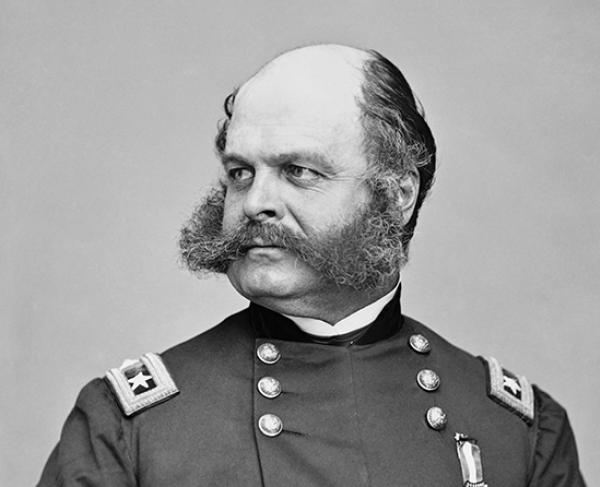
Ambrose Burnside Week
Happy Thanksgiving! Now on with our Turkey this week!
Lincoln issued the order to remove McClellan on November 5, 1862, and on November 7, 1862, he selected Burnside to take his place. Burnside reluctantly complied with this directive, the third such instance in his relatively brief career, partly due to the courier’s message that if he declined, command would instead be given to Maj. Gen. Joseph Hooker, whom Burnside had an aversion to.
The Battle of Fredericksburg is not a moment of shining glory for the US Army. We will be telling that story in 5 part harmony beginning next week. Not to spoil the fun, but I don’t think anyone here is surprised to hear that Lee won and Burnside lost. The battle and the subsequent ill-fated offensive led to Burnside’s officers voicing vehement complaints to the White House and the War Department, citing his incompetence. Burnside attempted a Spring offensive, only to encounter hindrances stemming from poor planning and organization.
Burnside offered his resignation, but Lincoln declined, proposing that there might still be a role for him within the army. Consequently, Burnside was reinstated as the head of the IX Corps and dispatched to command a relatively inactive department, a quiet region with limited activity. Lincoln’s rationale was that Burnside couldn’t get into significant trouble there. However, he swiftly found himself embroiled in a major political controversy.
Challenges
1) What was the Spring Offensive called and why did it fail? 2) Where was Burnside sent? 3) What was the kerfuffle Burnside precipitated by issuing General Order #38?

Answers
1) The Spring Offensive was known as the Mud March. Although conceptually clever, it was highly impractical for January in Virginia. Burnside’s plan was quite similar to Hooker’s strategy in the Battle of Chancellorsville, aiming to outmaneuver Lee using the upriver fords on the Rappahannock. Burnside intended to execute this with his cavalry, which had thus far delivered lackluster performances in the war. However, heavy rains in January transformed the roads into impassable mud, forcing the plan’s abandonment.
2) Burnside was assigned to the Department of the Ohio, which encompassed the states of Ohio, Indiana, Kentucky, and Illinois.
3) Burnside issued a series of orders in a region with divided loyalties and sentiments, seeking to suppress “the expression of public sentiments against the war or the Administration.” General Order No. 38, in particular, declared that “any person found guilty of treason will be tried by a military tribunal and either imprisoned or banished to enemy lines.” On May 1, 1863, Ohio Congressman Clement L. Vallandigham, a prominent opponent of the war, held a large public rally in Mount Vernon, Ohio in which he denounced President Lincoln as a “tyrant” who sought to abolish the Constitution and set up a dictatorship. Burnside had dispatched several agents to the rally who took down notes and brought back their “evidence” to the general, who then declared that it was sufficient grounds to arrest Vallandigham for treason. This led to the arrest and trial of Ohio Congressman Clement L. Vallandigham, a prominent war opponent, further fueling political discord. A military court tried him and found him guilty of violating General Order No. 38, despite his protests that he was simply expressing his opinions in public. Vallandigham was found guilty of violating General Order No. 38, and sentenced to imprisonment for the duration of the war. This turned him into a martyr by antiwar Democrats. Lincoln had to extricate the entire Republican administration from the fallout that Burnside had produced.
Join the Never Call Retreat Facebook Group to access these challenges daily!
 The Civil War Center
Leave a Reply