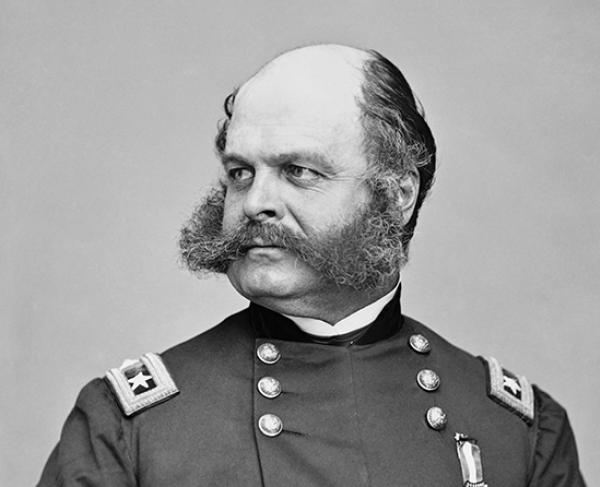
Ambrose Burnside Week
Those who have read David Copperfield by Charles Dickens may recall a recurring character named Uriah Heep, a man who was a phony from the start and keeps showing up in Copperfield’s life in various guises, but always predictably remains a phony. I recognize this caricature; I can name 2 such people in my life and professional career. Well, when I read Catton many years ago, Burnside struck me as the War’s Uriah Heep: wherever he showed up, which was repeatedly, like a low-grade comedy, he would instinctually make the wrong decision and inevitably snatch defeat from the jaws of victory. Grant in fact stated that whenever something went wrong, Burnside’s name almost always was involved. This is impressive work; you’d think that even randomly you could make the right call half the time.
During the Battle of Antietam, Burnside assumed command of the Right Wing of the Army of the Potomac, overseeing the I Corps and his own IX Corps at the outset of the Maryland Campaign. However, McClellan separated these two corps during the Battle of Antietam, stationing them at opposite ends of the Union battle line and restoring Burnside’s authority solely over the IX Corps. Burnside, implicitly refusing to relinquish his control, operated as if the corps commanders were first Maj. Gen. Jesse L. Reno (who was killed at South Mountain) and subsequently Brig. Gen. Jacob D. Cox, directing orders through them to the corps.
Challenges
1) The fact that Burnside delayed his attack on the Union left flank until the afternoon, particularly in the context of the stone bridge over Antietam Creek, now known as Burnside Bridge, likely influenced the battle’s outcome. McClellan might have secured victory if Burnside had acted differently. What transpired?
2) What other mistakes did Burnside make during the Battle of Antietam?
3) What were the consequences of Antietam for Burnside?
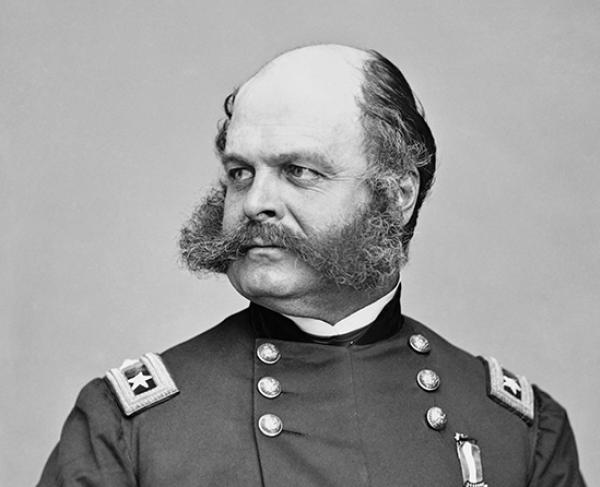
ANSWERS
1) A cumbersome command arrangement contributed to Burnside’s sluggishness in launching his attack and crossing the Rohrback, later Burnside’s Bridge, positioned on the southern flank of the Union line. This delay allowed Confederate forces to reinforce and ultimately repulse the Union breakthrough. Sears suggested in Landscape Turned Red that the problem was that Burnside felt he was demoted and was piqued. But its hard to imagine Burnside allowing a Union loss for that reason, and even harder to imagine that Lincoln would choose him to be the next CinC a month later if it were true.
The real story is far more complicated. McClellan sent his engineer to position Burnside but did so incorrectly. Rodman’s small force has to move on its own to Snavely’s Ford, which was the best downstream ford; this was too far away at this point for an alternative route. The idea that the Union forces could have waded across the Antietam Creek was based on a post war remark by out old friend, Henry Kyd Douglas. It was picked up by historians over the 20th Century, including Catton, who used it to make Burnside appear incompetent. The best guess is that it was not true, that there was just one ford, and it was far from ideal for a cross-river crossing under fire. This very complicated story is told in these two links: https://www.historynet.com/sculpting-a-scapegoat-ambrose…/ and https://warfarehistorynetwork.com/…/assault-on…/
2) Burnside failed to conduct a thorough reconnaissance of the area and failed to exploit easily accessible fording sites beyond the reach of Confederate forces. Instead, his troops were repeatedly forced into assaulting the narrow bridge, under the threat of Confederate sharpshooters on elevated terrain. McClellan, growing impatient, sent couriers to urge Burnside forward, even ordering, “Tell him if it costs 10,000 men he must go now.” Despite this, Burnside didn’t receive reinforcements, and the battle ended with missed opportunities. He further increased the pressure by sending his inspector general to confront Burnside, who reacted indignantly: “McClellan appears to think I am not trying my best to carry this bridge; you are the third or fourth one who has been to me this morning with similar orders.” The IX Corps eventually broke through, using a dangerous direct route as described in the links above, but the delay allowed Maj. Gen. A. P. Hill’s Confederate division to come up from Harpers Ferry and repulse the Union breakthrough. McClellan refused Burnside’s requests for reinforcements, and the battle ended.
3) Astonishingly, Burnside was offered command once more, despite his performance. He accepted reluctantly this time, as will be discussed tomorrow.
Join the Never Call Retreat Facebook Group to access these challenges daily!
 The Civil War Center
Leave a Reply